

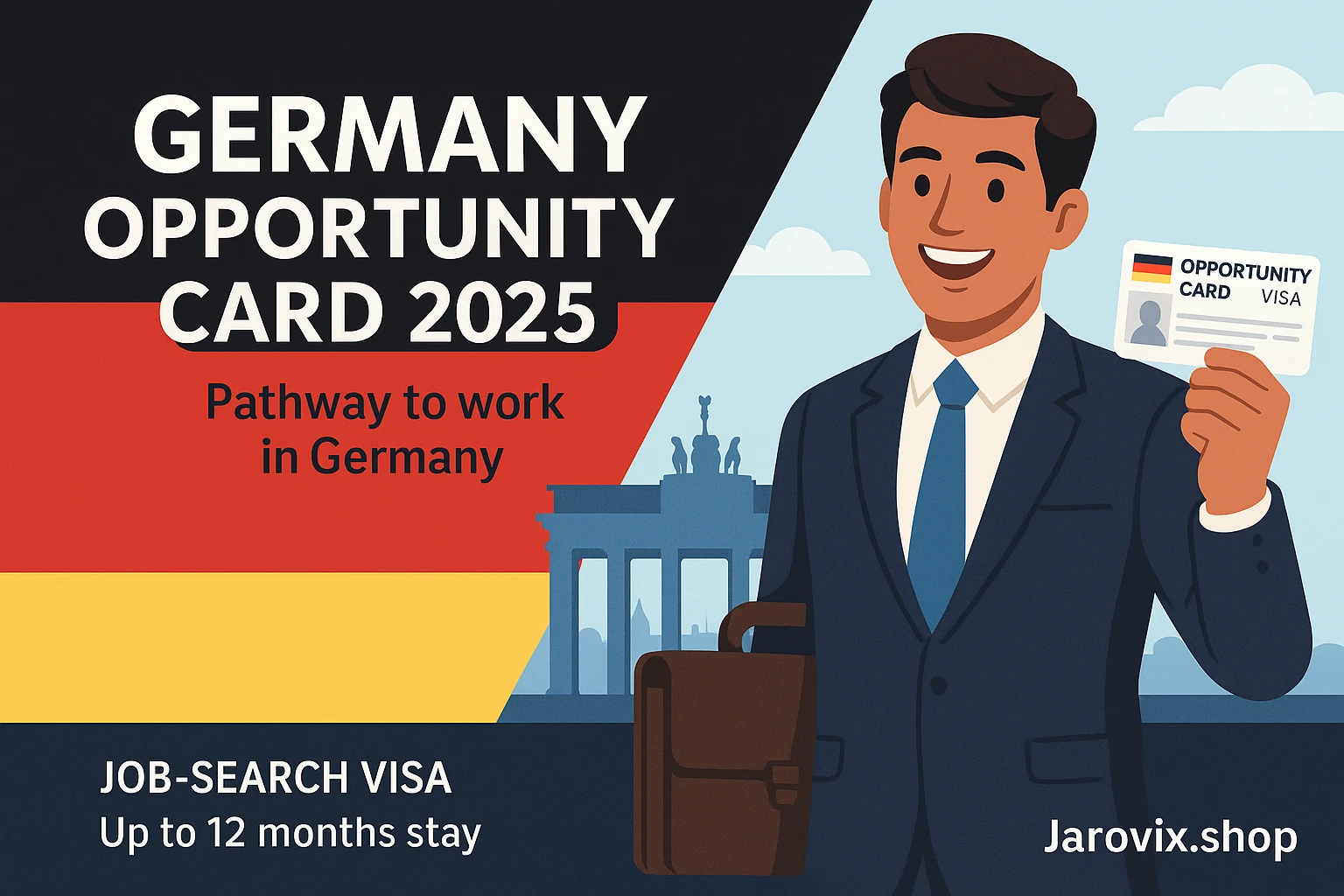
The all‑new Chancenkarte unlocks flexible work and settlement opportunities for skilled professionals who want to test the German labour market. Learn the benefits, points system, required documents and how to apply.
Germany • Skilled Immigration • Work & Residence Rights • 20 h/w work + PR pathway
The Germany Opportunity Card (Chancenkarte) is part of the country’s reformed Skilled Immigration Act. Beginning in 2024–25, it allows qualified non‑EU nationals to live in Germany for up to one year while searching for a job, working part time and laying groundwork for a permanent role. This long‑form guide explains who qualifies, how the points system works and why it could be your gateway to a German residence permit. Always double‑check official rules on the Federal Foreign Office’s site before submitting your application.
What is the Germany Opportunity Card?
The Opportunity Card (in German, Chancenkarte) is a new residency permit introduced under Germany’s Skilled Immigration Act. It’s designed for skilled non‑EU citizens who don’t yet have a job offer but want to explore employment in Germany. The card grants:
- Up to 12 months of residence to look for qualified work.
- Part‑time work rights up to 20 hours per week during your job search.
- Optional side jobs (so‑called “trial employment”) for up to two weeks with a prospective employer.
- Pathways to extend the residence permit and transition into a Blue Card or permanent residence once you secure an offer.
This flexible visa compliments Germany’s existing visa ecosystem for skilled workers (e.g. EU Blue Card, Job Seeker Visa). Unlike those options, the Opportunity Card uses a points system to evaluate applicants on education, language skills, experience, age and ties to Germany. As a result, you can qualify without a firm job contract.
Because the program is new, visa officers and employers may still interpret some rules differently. Always consult official resources and speak with a German embassy if you have unusual circumstances. The details in this guide are based on available legal drafts and HR commentary at the time of writing.
What are the benefits?
Flexibility
Search year 20 h/week work
The Opportunity Card grants a full year in Germany to look for work without the immediate pressure of a job offer. You can explore different cities and employers, network and even complete trial employments.
Low entry barrier
Points system No binding contract
You can qualify by scoring at least six points across education, experience, language and age criteria. This reduces reliance on a job contract, which is often required for other visas.
PR pathway
Blue Card Permanent residence
After securing a qualified role in Germany, you can convert your Opportunity Card into an EU Blue Card or other work permit. From there, long‑term residence and eventual permanent residency are possible under German immigration rules.
Important note: The card does not guarantee a job; it simply allows you to live and work part time while searching. You must prove sufficient funds to support yourself in Germany (around €12,324/year) and return home if you don’t find employment. Always consult official sources for updates.
Eligibility & points system
To be eligible for the Opportunity Card, you must meet baseline requirements and accumulate at least 6 points in the German government’s scoring model. Key conditions include:
- Recognized qualifications: You need either a German university degree or an equivalent foreign qualification. If your degree isn’t recognised, you might still qualify with substantial professional experience (3+ years) and training.
- Language skills: At least German A1 or English B2 proficiency is required. Higher proficiency scores more points.
- Financial proof: Show you have funds for living expenses (approx. €12,324 for 12 months).
- Health insurance: You must have valid health coverage for your stay.
Points system breakdown
The points system values a combination of qualifications, experience, language, age and “Germany connection”. To qualify, accumulate at least 6 points (the maximum is 14). Here is a summary based on HR guides and draft regulations:
| Category | Points | Notes |
|---|---|---|
| Recognised degree (vocational or academic) | 4 points | Degree must be comparable to German qualifications. |
| Qualification with 2 years experience | 3 points | For non‑recognised diplomas but relevant work experience. |
| Professional experience (minimum 5 years) | 2 points | Can supplement lower educational points. |
| Language skills (German B1 or higher) | 2 points | B2, C1 etc. earn more; English B2 also counts. |
| Previous stay in Germany (6 months) | 1 point | For example, studying or working temporarily. |
| Under 35 years | 2 points | Younger applicants score higher. |
| Under 40 years | 1 point | Still beneficial to be under 40. |
| Accompanying spouse meeting criteria | 1 point | If your spouse also qualifies. |
These values are indicative; always verify the latest official points table when you apply, as the government may adjust weightings and categories. If you’re unsure whether your degree counts, use the ANABIN database to check equivalence.
How to apply: step‑by‑step process
- Self‑assessment: Use official or HR tools (like the “Chancenkarte self‑check”) to estimate your points and confirm you meet the baseline criteria for qualifications and funds.
- Gather documents: Collect proof of education (degrees, transcripts), certificates of employment, language test certificates (Goethe, IELTS etc.), health insurance, passport and bank statements verifying funds.
- Submit application: Apply through the German embassy/consulate in your country or the Consular Services Portal. Complete forms, upload documents and pay the fee (around €75).
- Wait for processing: The processing time is expected to range from 3–5 months depending on workload and completeness. You may be asked to attend an interview or provide additional documents.
- Enter Germany: Once approved, you’ll receive a visa to enter Germany. After arrival, register your address, obtain a residence permit card at the local foreigners’ authority (Ausländerbehörde) and start your job hunt.
- Secure employment: Use job portals, networking events and your 20h/week employment allowance to find a qualified role. Once you have a contract that meets salary thresholds (often aligned with Blue Card requirements), you can convert your permit to a work visa or Blue Card.
Salary expectations & high‑demand jobs
Germany’s labour market seeks professionals in IT, engineering, healthcare, skilled trades and research. Salary expectations vary by industry and region, but here are some typical annual ranges (gross, before tax) for positions that often meet Blue Card thresholds:
Software & IT
€50k–€80k (Senior roles up to €100k)
Backend developers, cloud engineers, data scientists and AI specialists are in high demand. Berlin, Munich and Frankfurt host many tech startups and multinational firms.
Engineering & manufacturing
€45k–€75k (Mechanical, electrical, automotive)
Germany remains an engineering powerhouse with automotive giants (BMW, VW, Mercedes) and clean‑tech innovators. Skilled engineers with German language skills have an edge.
Healthcare & nursing
€35k–€55k
Nursing shortages persist across the country, leading to streamlined procedures for qualified nurses to obtain recognition and work permits. B2 German is often required.
Note that salaries depend on experience, negotiation and region. For Blue Card conversion, the minimum annual salary requirement is typically around €43,992 (as of 2023 for shortage occupations). The Federal Employment Agency publishes updates each year.
German cost of living: Expect to budget €900–€1,300/month for rent, utilities and expenses in cities like Berlin or Munich. Proof of funds ensures you won’t rely on state support during your search.
Other visas & permanent residence pathways
The Opportunity Card is one of several routes into Germany’s labour market. Depending on your situation, consider these alternatives:
- EU Blue Card: Designed for highly skilled professionals with a university degree and a job offer paying the required salary. It’s a fast track to permanent residency and allows EU mobility.
- Job Seeker Visa: Allows up to 6 months in Germany to find a job but doesn’t permit part‑time work. Less flexible than the Opportunity Card.
- Skilled Worker Visa: For non‑academic vocational professionals with recognized training and a job offer.
- Research Visa & Artist Visa: Tailored to researchers, PhD candidates and creatives with project sponsorship.
Once you secure a qualifying job and meet language/integration requirements, you can pursue long‑term residence. Permanent residency is generally available after four years on a Blue Card or five years on other permits (with contributions to pension and language integration).
Comparisons with other countries’ programs
The concept of an Opportunity Card is reminiscent of Canada’s category‑based Express Entry draws, which prioritize occupations like STEM and healthcare. Similarly, Germany is targeting skilled workers in shortage fields. Meanwhile, the UK’s Skilled Worker visa has increased salary thresholds in 2025, making Germany’s cost of entry comparatively attractive. France and the Netherlands also offer “search year” visas for graduates and skilled migrants. Research your options and choose the program best aligned with your qualifications and career goals.
Tips, FAQs & resources
Expert tips for applicants
- Invest in language: Even basic German (A2/B1) will improve your job prospects and integration. Many employers require German for internal communication.
- Network proactively: Join LinkedIn groups, attend meetups and leverage alumni networks. A job offer may come from connections rather than cold applications.
- Prepare translated documents: Notarised translations and apostilles of diplomas are essential. Incomplete documents cause delays.
- Plan finances: Open a blocked bank account or maintain sufficient funds in your home country. You need to prove you can sustain yourself for a year without state assistance.
- Consult professionals: Immigration lawyers or relocation consultants can help interpret rules and prepare compelling applications.
Frequently asked questions
Is the Opportunity Card the same as the Job Seeker Visa?
No. While both allow you to search for a job in Germany, the Opportunity Card uses a points system and lets you work part time (20 h/week) during your search. The Job Seeker Visa does not permit work but is simpler to obtain for some applicants.
What happens if I don’t secure a job within 12 months?
You must leave Germany when your permit expires. Extensions may be possible only if you score additional points (e.g., through language improvement) or meet criteria for other permits. Always consult the local foreigners’ office.
Do I need a German job offer to apply?
No. The Opportunity Card is specifically designed for applicants without a job offer. However, you must prove your qualifications and funds.
Can I bring my family?
Family reunification is not guaranteed with the initial Opportunity Card. If you secure a long‑term work visa or Blue Card, you can typically sponsor your spouse and children.
How does this program compare to Canada’s Express Entry?
Canada’s Express Entry uses a Comprehensive Ranking System (CRS) evaluating age, education, language and work experience. It leads directly to permanent residence. Germany’s Opportunity Card is more like a “job search year” permit with a simpler points system and requires a subsequent visa for long‑term stay. Both aim to attract skilled workers in shortage occupations.
• Visa rules change frequently. Always check the Federal Foreign Office and immigration authorities for current requirements before applying. This guide is for informational purposes and not legal advice.